Character limits by platform: X, Bluesky, Instagram, LinkedIn, Ads
Updated October 12, 2026 · 7 min read · 7 sections

A post that reads 276 of 280 in one counter can be refused by the app, and a post that looks too long can go through. Every network measures in its own unit, so a character counter that applies one raw length to everything misleads you most on exactly the texts that contain links, emoji or Japanese.
I cut copy to fit boxes for a living, and the first rule I teach is to count the way the platform counts, not the way a word processor does. This guide gives you the units, the limits, and the traps for X, Bluesky, Instagram, LinkedIn and Google Ads. Platforms change their limits now and then, so treat the numbers as a starting point and confirm in the composer when it matters. The character counter on this site lets you set your own limit for that reason.
One text, four different lengths
Take the line english text 日本語 😷 https://example.com. It is the reference example in the open-source twitter-text library, and it shows how far apart the units drift.
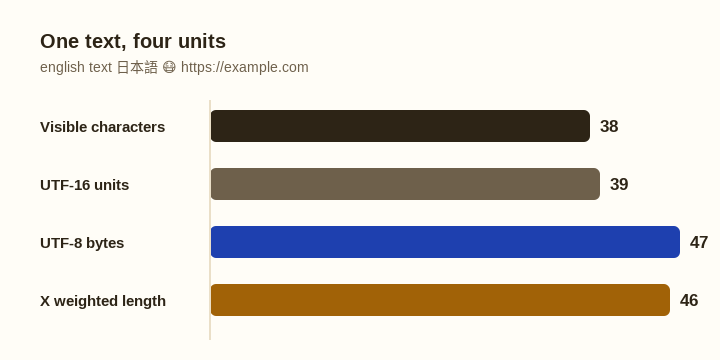
- Visible characters (graphemes): what your eye counts. Here 38.
- UTF-16 units: what JavaScript reports as
length. The emoji takes two units, so 39. - UTF-8 bytes: what a database field or a byte cap sees. Latin letters take one byte, each Japanese character three, the emoji four: 47.
- X weighted length: 13 Latin characters and spaces, 3 x 2 for the Japanese, 1 space, 2 for the emoji, 1 space and 23 for the link: 46.
Four numbers, one text. Which one matters depends on where you are posting. Single symbols spread the same way:
| Symbol | Visible | UTF-16 | UTF-8 bytes | X weight |
|---|---|---|---|---|
| 😀 | 1 | 2 | 4 | 2 |
| 👨👩👧 (family) | 1 | 8 | 18 | 2 |
| 🇺🇦 (flag) | 1 | 4 | 8 | 2 |
| é typed as e + accent | 1 | 2 | 3 | 1 (after normalising) |
The limits, and the unit behind each one
| Where | Limit | Counted as |
|---|---|---|
| X post | 280 | Weighted length: URL = 23, emoji and CJK = 2 |
| Bluesky post | 300 | Graphemes, plus a 3,000-byte ceiling |
| Threads post | 500 | UTF-16 units in the tool (strict) |
| Mastodon (default server) | 500 | Code points, URL = 23; each server can change it |
| LinkedIn post | 3,000 | UTF-16 units in the tool (strict) |
| Instagram caption | 2,200 | UTF-16 units in the tool (strict) |
| Instagram bio | 150 | UTF-16 units in the tool (strict) |
| Google Ads headline / description / path | 30 / 90 / 15 | Characters, Chinese, Japanese and Korean = 2 |
"Strict" means the tool counts an emoji as two. It is the safe direction: if the strict count fits, the post fits whichever way the app counts. Facebook, YouTube, TikTok and Pinterest are in the tool as presets only; I have no documented rule to quote for them, so check the app before you rely on those.
The sources: X publishes its rules in its counting characters documentation; LinkedIn states 3,000 in its help centre; Instagram's 2,200 and 150 are reported by NapoleonCat; the Bluesky, Threads and Mastodon figures are collected by howmanywords.
X: weighted length, links and CJK
X does not count characters one for one. Text is normalised first, then each character is weighed: Latin letters, digits and common punctuation weigh 1, emoji and CJK characters weigh 2, and every link weighs 23 whatever its real length. The limit of 280 is a weight, which is why a Japanese post holds only 140 characters.
| Text | Raw characters | X weighted | Left of 280 |
|---|---|---|---|
Read https://example.com/a/very/long/path/that/goes/on/and/on/for/ever ok | 73 | 31 | 249 |
| 140 x 日 | 140 | 280 | 0 |
| 141 x 日 | 141 | 282 | 2 over |
Launch day 🚀 | 12 | 13 | 267 |
The first row is the one that surprises people. The line is 73 characters long, the link alone is 65 of them, and X charges 23 for it: 5 + 23 + 3 = 31 once you add the words around it. A counter that adds the raw length would tell you that you used a quarter of your room when you used one ninth.
Bluesky: graphemes first, bytes second
Bluesky allows 300 graphemes, so a family emoji is one character and an accented letter is one character however it was typed. There is also a 3,000-byte ceiling on the text. For ordinary writing you never meet it: 300 Latin letters are 300 bytes. It bites on emoji-heavy posts. A family emoji is 18 bytes, so 166 of them already reach 2,988 bytes and a 167th would pass the ceiling long before the 300-grapheme limit. Nobody posts that, but a string of long ZWJ emoji gets close faster than you would expect, and the byte count is shown in the tool for that reason.
Instagram and LinkedIn: the limit is not the problem, the fold is
Nobody writes 2,200 characters of caption by accident, and a LinkedIn post of 3,000 characters is far past what most readers finish. The number that decides whether anything gets read is the fold. Guides commonly report that an Instagram caption shows only about the first 125 characters, or three lines, before a "more" link; LinkedIn hides the rest of a post behind "see more" too, and the cut-off differs by device and is not published. So I write the hook to survive the cut: the claim, the number or the question goes first, and the hashtags, the thanks and the link go below it.
Google Ads: double-width characters
Responsive search ads take headlines of 30 characters, descriptions of 90 and display paths of 15, and Google's help page states that each character of a double-width language, meaning Chinese, Japanese and Korean, counts as 2. So the Japanese headline 東京の格安ホテルを今すぐ予約 has 14 characters and counts 28 of 30. The English Cheap Tokyo Hotels – Book Now counts 29 of 30, with the en dash as a single character. Google also says some lines can be shortened with an ellipsis when it assembles the ad, which is one more reason to keep every headline readable on its own.
Cross-posting without surprises
- Write to the strictest count. If the post must run on X and Bluesky, the 280 weighted limit on X is the one to meet. Apart from links, a text that fits there fits Bluesky's 300; a link costs 23 on X but its full length on Bluesky, so check that case on both rows.
- Paste plain text. Hidden formatting, odd spaces and look-alike characters from a document change the count.
- Shorten the link anyway. A link costs 23 on X whatever its length, but its full length on LinkedIn and most other places, so a short link is free on X and a saving everywhere else.
- Count emoji as two when unsure. The strict count is the one that never lets you down.
- Read the text that sits past the limit. Highlighting the overflow in the editor shows which words would be cut, which is better than a bare number.
If your post goes to phones as a text message, the rules change again; the SMS character limit guide covers that. For titles and descriptions in search results, see meta title and description length, and for essay limits, how many pages is 1,000 words.
Common questions
How many characters can I post on X?
280 weighted characters. Latin letters, digits and punctuation weigh 1, emoji and Chinese, Japanese or Korean characters weigh 2, and every link weighs 23 whatever its length, so a Japanese post holds about 140 characters.
Does an emoji count as one or two characters?
It depends on the platform. X counts every emoji as 2, Bluesky counts it as 1 grapheme, and counters based on JavaScript string length report 2 or more. The strict count of 2 is the safe choice when cross-posting.
Do links count at their full length?
On X every link counts as 23 characters. LinkedIn and most other places count a link at its real length, so a long tracking link costs far more there than on X.
Why does a Google Ads headline show more characters than I typed?
Chinese, Japanese and Korean characters are double-width and count as 2 each, so a 14-character Japanese headline uses 28 of the 30 allowed.
Are the limits for Facebook, YouTube, TikTok and Pinterest reliable?
They are presets in the tool without a documented rule behind them. Platforms change these limits, so confirm in the app before you depend on one.


