SMS character limit: 160, 153, 70 and why one emoji splits your text
Updated October 12, 2026 · 6 min read · 7 sections

A reminder of 150 plain characters goes out as one text. Add a single rocket emoji and the same reminder goes out as three. The SMS character limit is not one number: it depends on the alphabet your message ends up in, and one stray character decides which alphabet that is.
I have watched campaigns triple in size because a copywriter pasted from a word processor. The fix is cheap once you know what to look for, and a character counter that shows the encoding, the segments and the characters to blame finds it in a second.
Two alphabets, two sets of numbers
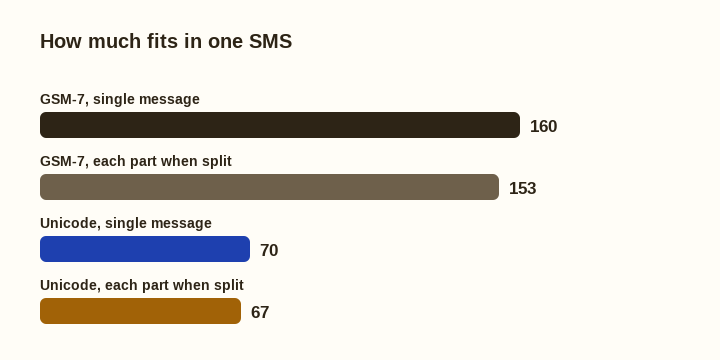
A text message is stored in one of two encodings. GSM-7 is a compact 7-bit alphabet with the basic Latin letters, digits, common punctuation and a handful of accents. Anything outside it, such as a curly quote, an emoji or most Asian scripts, forces the whole message into UCS-2, a 16-bit encoding that carries much less per message. Messaging provider Bird documents the capacities in its SMS character limits guide, and other providers publish the same figures.
| Segments | GSM-7 units | UCS-2 units |
|---|---|---|
| 1 | 160 | 70 |
| 2 | 306 (2 x 153) | 134 (2 x 67) |
| 3 | 459 (3 x 153) | 201 (3 x 67) |
Why 160 becomes 153 and 70 becomes 67
A message that does not fit in one SMS is cut into parts, and each part has to say where it belongs so the phone can glue them together. That reassembly information, the User Data Header, takes room from every part. As DIDLogic's explanation works out, six bytes of header leave 134 bytes for text, which is 67 UCS-2 characters, and in GSM-7 the header costs seven character positions, leaving 153. So 161 plain characters is not "160 plus one". It is two segments, and the second carries 8 characters.
The characters that cost two
Inside GSM-7, nine characters live in an extension table and cost two units each: ^ { } \ [ ] ~ | and the euro sign €. They do not push you into Unicode, but they eat room, as the Messangi documentation lists. The euro sign is the one that catches price messages.
| Message | Units | Segments |
|---|---|---|
| 160 x a | 160 | 1 (0 left) |
| 161 x a | 161 | 2 (145 left) |
| 159 x a + € | 161 | 2 |
| 80 x { | 160 | 1 |
| 81 x { | 162 | 2 |
| 152 x a + € + 10 x a | 164 | 2 (141 left) |
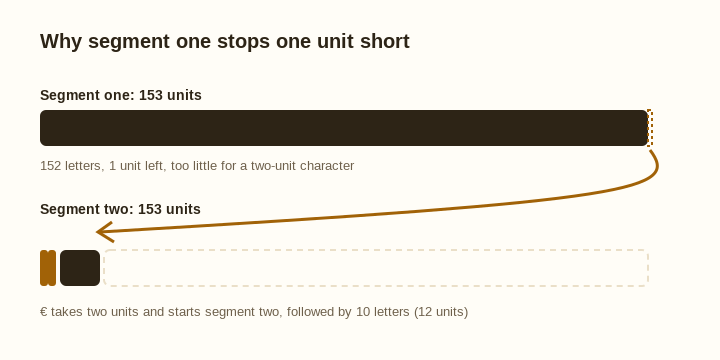
The last row shows a rule that surprises people. Segment one holds 153 units. After 152 letters there is one unit left, but the euro sign needs two, and a two-unit character is never split across parts, so it moves whole into segment two. The message is 164 units, yet it splits as 152 units in segment one and 12 in segment two: segment one is left one unit short on purpose.
Smart quotes and dashes: the silent switch
This is the mistake behind most surprise bills. Word processors turn straight quotes into curly ones, hyphens into en dashes and three dots into one ellipsis character. None of them is in GSM-7. Take Don’t forget “tomorrow” – see you: 33 characters, but the apostrophe, both quotes and the dash force Unicode, so it uses 33 of 70 units and 37 are left. Replace them with plain versions and Don't forget "tomorrow" - see you is GSM-7 at 33 of 160, with 127 left.
| From a word processor | Plain replacement |
|---|---|
| ’ ‘ (curly apostrophe, single quotes) | ' |
| “ ” (curly double quotes) | " |
| – — (en and em dash) | - |
| … (ellipsis character) | ... |
| Non-breaking or thin space | an ordinary space |
The counter's "Make SMS-safe" button does these swaps and normalises accents typed as a letter plus a combining mark, removes zero-width characters, then shows you the result before you accept it, with a one-step undo.
Emoji and accented letters
An emoji is never in GSM-7, so one emoji flips the message to UCS-2, where it also takes two units. Count it for yourself: 150 letters plus one emoji is 152 units, over 70, so it splits into segments of 67. That is 67 + 67 + 18 = 152, three segments, and 49 left in the last one. The same 150 letters without the emoji are one.
Accents are more mixed. GSM-7 includes é è ù ì ò ñ ü ö ä à and a capital Ç, but not a lowercase ç, nor ê, ã, á, í, ó or ú. For Spanish and Portuguese this matters. Tu cita es mañana a las 10 stays in GSM-7 because ñ is in the table, while Tu cita es a las 10 en la clínica goes to Unicode on the í. A Portuguese reminder with one ã is Unicode and so a message of 100 characters costs 2 segments instead of 1. French fares better: Votre RDV est confirmé à 10h, à demain stays in GSM-7.
What segments mean for a campaign
Providers normally bill per segment, so the arithmetic is simple: segments per message times recipients. A 2-segment message to 5,000 people is 10,000 segments, and bringing it to one segment halves that. I always trim and sanitise before a send, and I test a sample in the encoding the recipients will really get.
There is also a ceiling on length. The cap on joined segments depends on the carrier and gateway, and Bird's documentation, for one, accepts at most 12 segments, which is 1,836 GSM-7 units or 804 UCS-2 units. If your text needs more than three segments, ask whether it should be a link.
Checklist before you send
- Paste into a plain-text field first. It strips formatting but not curly quotes, so still check.
- Read the encoding badge. If it says Unicode, look at the list of characters that forced it; the panel counts the message in parts, which are the segments of this guide.
- Swap smart punctuation for the plain forms in the table above.
- Drop the emoji unless it earns its extra segments.
- Count € and brackets twice. They are two units each.
- Stay a few units under a boundary. At 150 to 160 or 300 to 306 a name merged into the text can tip you over.
- Multiply segments by recipients and decide if the text is worth that number.
The same habit of counting in the platform's unit applies to posts, in character limits by platform, and to search results, in meta title and description length. For long documents, how many pages is 1,000 words turns words into pages.
Common questions
How many characters fit in one SMS?
160 if every character is in the GSM-7 alphabet, 70 if even one character is not and the message becomes Unicode (UCS-2).
Why do long texts split at 153 and 67 characters?
Each part of a split message carries a header that tells the phone how to reassemble it. The header takes room, so GSM-7 parts hold 153 units and Unicode parts hold 67.
Does an emoji change the SMS length?
Yes. An emoji is not in GSM-7, so the whole message switches to Unicode and the limit drops from 160 to 70 for a single message. The emoji itself takes two units.
Do the euro sign and curly brackets count double?
Yes. The euro sign and the characters ^ { } \ [ ] ~ | take two units each, but they stay inside GSM-7 and do not force Unicode.
Are accented letters safe in an SMS?
Some are. é, è, ù, ì, ò, ñ, ü, ö, ä and à are in GSM-7, but ê, ã, á, í, ó, ú and a lowercase ç are not, so Portuguese and Spanish texts often turn into Unicode.


