How many pages is 1,000 words? Word counts, pages and reading time
Updated October 12, 2026 · 5 min read · 5 sections

1,000 words is about 2 pages single-spaced or 4 pages double-spaced, 4 minutes 13 seconds of silent reading and 6 minutes 40 seconds if you read it aloud at a speaking pace. Those figures rest on conventions, and knowing which ones lets you adjust when your assignment or your font disagrees.
People ask this question for three different jobs: filling an essay requirement, timing a speech, and estimating how long a reader will spend. The numbers differ for each, and a good word counter, such as the character counter on this site, shows pages and times next to the word count so you do not do the sums twice.
The pages convention
The usual rule is 500 words per single-spaced page and 250 per double-spaced page, for 12-point type with standard margins. It is a convention, not a standard. A wide font, large margins, many headings or short paragraphs all lower the count, and a compact font raises it. Treat the table as a plan and check the real page count in your word processor before you submit. The counter lets you change the words-per-page values for that reason.
| Words | Pages, single-spaced | Pages, double-spaced | Silent reading (238 wpm) | Speaking (150 wpm) |
|---|---|---|---|---|
| 250 | 0.5 | 1 | 1 min 4 sec | 1 min 40 sec |
| 500 | 1 | 2 | 2 min 7 sec | 3 min 20 sec |
| 750 | 1.5 | 3 | 3 min 10 sec | 5 min 0 sec |
| 1,000 | 2 | 4 | 4 min 13 sec | 6 min 40 sec |
| 1,500 | 3 | 6 | 6 min 19 sec | 10 min 0 sec |
| 2,000 | 4 | 8 | 8 min 25 sec | 13 min 20 sec |
| 2,500 | 5 | 10 | 10 min 31 sec | 16 min 40 sec |
| 3,000 | 6 | 12 | 12 min 37 sec | 20 min 0 sec |
| 5,000 | 10 | 20 | 21 min 1 sec | 33 min 20 sec |
Rounded up to the next second, using 500 and 250 words per page. The last two columns are the ones to plan around: a 750-word piece is a five-minute talk, 1,500 words is ten, and 3,000 words is twenty.
What moves a page count more than anything else: line spacing (double spacing halves the words per page), font and size, margins, and block elements such as headings, tables, quotations and images. Every heading and short paragraph leaves white space that the word count does not see.
Reading time: where 238 comes from
You often see 200 or 300 words per minute. The best single source I know is a review of 190 studies, summarised by the British Psychological Society and published as Brysbaert's meta-analysis. It puts adult silent reading of English non-fiction at about 238 words per minute and fiction at about 260. Most adults fall between 175 and 300, and the paper argues that the popular 300 is too high. Reading aloud is slower, at about 183.
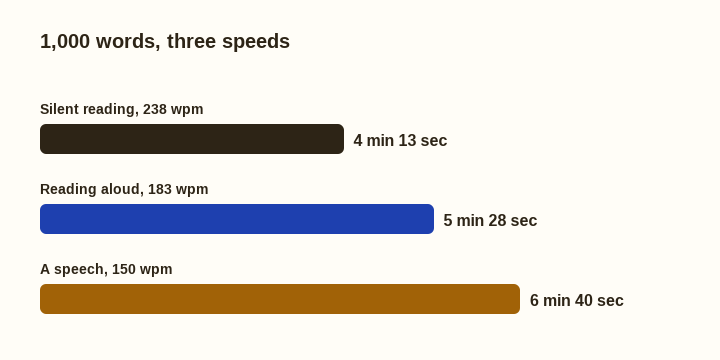
My working rule: use 238 for how long a reader will need, and 150 for a speech. The 150 is a presentation pace with room for pauses, not a research figure, and the counter lets you change it. A nervous speaker rushes and a trained one slows down for emphasis, so rehearse once with a timer and replace my number with yours.
Doing the sums by hand
- Pages: divide the words by 500 for single spacing or 250 for double. For 1,500 words that is 3 and 6 pages.
- Reading time: divide the words by 238 and multiply by 60 for seconds. 1,500 / 238 x 60 = 378.15, which rounds up to 379 seconds, or 6 minutes 19 seconds.
- Speaking time: divide by your pace. 1,500 / 150 = 10 minutes exactly.
- Turn it around: a 12-minute slot at 150 wpm is 1,800 words, minus the time for slides, questions and breathing.
Characters with spaces or without
Some forms and applications set a limit in characters instead of words, and a few do not say whether spaces count. The two figures differ by roughly one character per word. The sample text built into the tool has 148 words, which come to 1,023 characters with spaces and 873 without. Your own ratio will vary with word length and punctuation.
If the instruction is silent, read the form's own example or its error message, and keep your text under the limit by both measures. A short sentence of explanation in the box often settles it. Characters here means visible characters, so an emoji or an accented letter counts as one, whichever way the form software measures it internally.
Why two word counters disagree
The gap between counters is usually a few words in a thousand, and it comes from the same few choices:
- Hyphens and slashes. Is
state-of-the-artone word or four? The tool counts it as one, as most word processors do, and some online counters split at the hyphen. - Stand-alone symbols. A spaced dash or an ampersand is not a word.
Hello — worldis 2 words, though a counter that splits on spaces says 3. - Numbers and prices.
$3.50is a single word. - Languages without spaces.
日本語のテキストhas no spaces, so a space-splitting counter says 1 word. Word processors count each Han, Hiragana or Katakana character as a word, which gives 8. - Footnotes, headers and text boxes. Some tools include them, some do not.
If a limit is strict, use the counter that the person checking it will use, and leave a margin of one or two percent.
Related counting questions are covered elsewhere on the site. Character limits by platform deals with posts and ads, the SMS character limit with text messages, and meta title and description length with search results.
Common questions
How many pages is 1,000 words?
About 2 pages single-spaced or 4 pages double-spaced, using the common convention of 500 and 250 words per page in 12-point type with standard margins. Font, margins and headings change it.
How long does it take to read 1,500 words?
About 6 minutes 19 seconds at 238 words per minute, the average silent reading rate for adult non-fiction found in a review of 190 studies.
How many words can I say in 10 minutes?
About 1,500 at a presentation pace of 150 words per minute. Allow for pauses and slides, and time yourself once to find your real pace.
Do characters with spaces or without spaces count toward a limit?
It depends on the form. The two figures differ by about one character per word, so check the instructions or keep your text under the limit by both measures.
Why does my word count differ between programs?
Counters treat hyphenated words, stand-alone dashes, numbers, footnotes and languages without spaces differently, so a gap of a few words per thousand is normal.


